
How to Search Henderson County Criminal Dockets
The official Henderson Odyssey Public Access page is your first branch point. Pick Criminal Records there, not Jail Records and not Jail Bond Records. An exact cause number is the strongest search key. Without one, work through the public fields the page presents. Try party-name spelling variants next. Add court or date filters if the first pass comes back empty. A complete Henderson County criminal docket search rarely stops at one tool. Layer the county portal with a court-specific Judicial Web Search and statewide re:SearchTX. The clerk's counter, a public terminal, or a direct call fills any gap that remains.
- Identify the offense level and likely court.
- Choose Criminal Records and search the exact cause number first.
- Open the match and note its court, filing date, status, and latest setting.
- Review a linked document only when it is actually viewable.
- Ask the proper clerk for a missing entry or certified judgment.
Save the category, your exact query, and the search date each time. A blank result can mean the wrong court, a misspelled name, a delayed index, or restricted access rather than a case that does not exist.
Henderson County Criminal Dockets Have Two Clerks
Court level decides which clerk keeps the criminal docket. Felonies sit with the district-court system and start at the District Clerk. County misdemeanors run through the constitutional County Court or the two County Courts at Law. The County Clerk's Criminal Division maintains those misdemeanor records. It also handles warrants, summonses, subpoenas, and commitments.
| Matter | Likely court | Records contact |
|---|---|---|
| Felony | 3rd, 173rd, or 392nd District Court | District Clerk, 903-675-6115 |
| County misdemeanor | County Court or County Court at Law | County Clerk, 903-675-6140 |
| Fine-only Class C | Justice or municipal court | Precinct or city clerk |
This split is what protects you from a false negative. A city or JP citation may never surface in the same Henderson County criminal docket category as a felony, so searching the wrong clerk proves nothing.
What a Criminal Docket Shows
A criminal docket is a dated register, not the whole file. The header usually carries the cause number, court, judge, filing date, case style, and status. Rows below it can log the charging instrument, arraignment, plea, motions, orders, settings, bond events, judgment, sentence, appeal, and disposition date. Treat those as fields to inspect. The online form makes no promise that every one appears on screen.
| Charge | The offense, statute, and classification if displayed. |
|---|---|
| Plea | The response entered in court, read with its date and order. |
| Setting | An arraignment, hearing, docket call, pretrial, or trial date. |
| Disposition | The recorded outcome, checked against the judgment. |
| Restriction | A seal, expunction, or juvenile rule may reduce public detail. |
The County Clerk's own disclaimer puts it plainly: an index points toward documents but is not the document itself. A label like "Disposed" never substitutes for reading the final judgment.
Henderson County Criminal Docket Versus Jail Status
Odyssey sorts its offerings into Criminal Records, Jail Records, and Jail Bond Records. A Henderson County criminal docket logs prosecution events only. Jail information tracks custody. The bond tile holds bond data. One result cannot safely stand in for another. Release, custody, or payment data never proves the court case ended. The official Odyssey source presents those three choices as separate tiles.
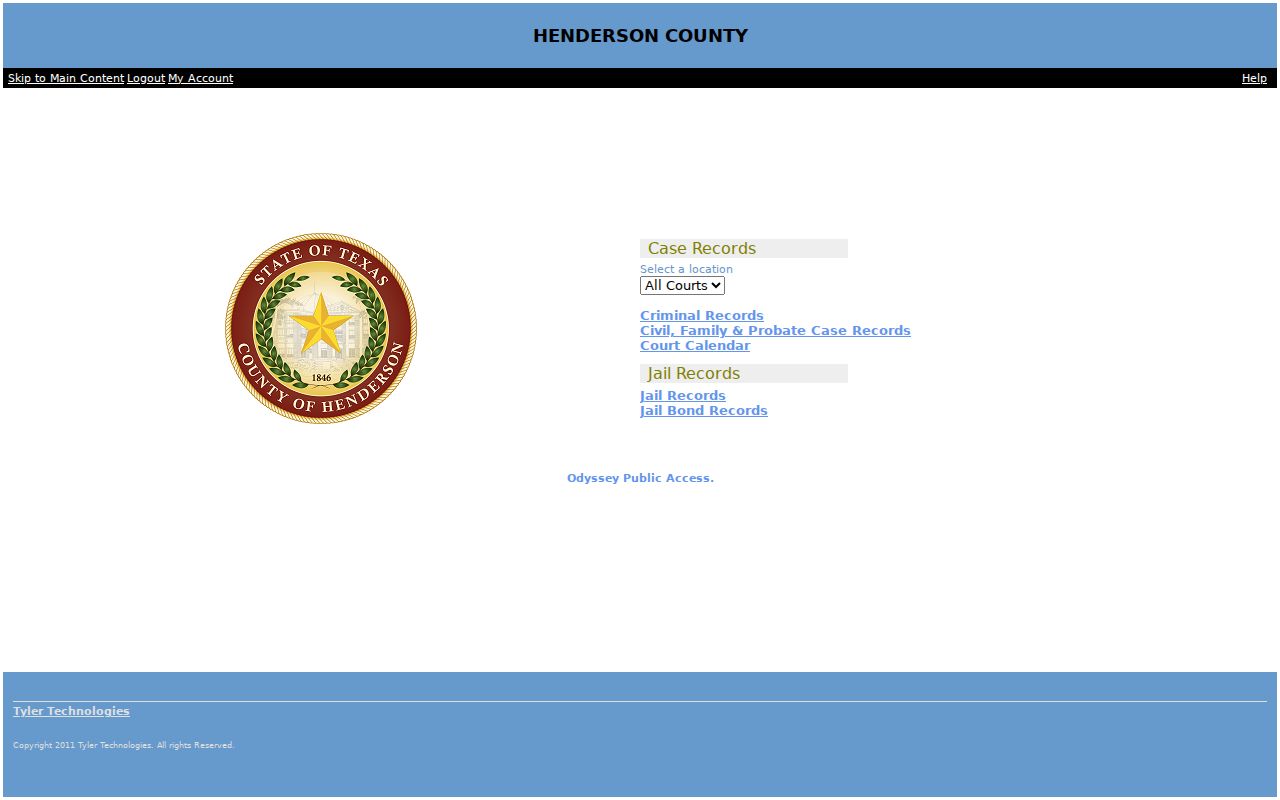
The tiles teach the right workflow. Use Criminal Records for case events, then a jail or bond source for its own narrow subject. Confirm any bond setting with the court or clerk, since a portal view can lag behind a signed order.
Note: Court status, custody status, and bond status can change on different schedules and should be checked separately.
Stages on a Criminal Docket
A Henderson criminal case creates a sequence rather than one decisive line: Filing → Arraignment → Pretrial → Plea or Trial → Disposition → Sentencing. Not every case uses every stage, and motions, orders, or resets may appear between them. An indictment or information is the charging instrument. Arraignment addresses the charge and plea process. A motion asks the court to act; an order states the judge's direction.
Settings trip people up. A notice can sit beside an old date long after a continuance. Read the newest entry and the signed order. When timing truly matters, call the named court's coordinator. A plea entry, likewise, says nothing about the outcome on its own. Check further before assuming anything. The judgment, sentence, or later disposition settles it. Bond events follow their own sequence. Henderson County works under a standing order on bail decisions. A 392nd District Court procedure also governs presenting grand-jury indictments for bond setting. Those materials describe process; they are not a live bond database. The current case entry, the signed order, and confirmation from the court still control.
Read Henderson County Criminal Docket Outcomes
Short labels compress major events into a few letters. Henderson County publishes no universal abbreviation list, so confirm common shorthand against the displayed entry or the clerk's record.
- Arraignment
- A proceeding where the charge and plea process are addressed.
- Continuance or reset
- A setting moved later, not a dismissal.
- Disposition
- The recorded result and date.
- Bond forfeiture
- An entry about an alleged failure to meet a bond obligation.
- Capias
- Court process directing custody, read with the order.
Codes such as MOT, ORD, CONT, and DISP usually signal motion, order, continuance, and disposition. Hold that reading loosely until the Henderson entry or the clerk confirms it.
Which Court Holds Criminal Dockets
Henderson County runs the 3rd, 173rd, and 392nd District Courts. Amended local rules give the 392nd preference for criminal cases. That does not put every felony on one court page. The cause number in your result identifies the actual court. Assigned misdemeanor work goes to the constitutional County Court. The two County Courts at Law take some as well. Justice and municipal courts sit outside that system. They hear fine-only Class C matters from their precinct or city. For a citation, identify the issuing court before calling any county clerk. Reach the 3rd at 903-677-7277. Reach the 173rd at 903-675-6107. The 392nd answers through the county directory at 903-675-6110. Verify current room and coordinator details before a visit. The Henderson County case search offers a broader lookup workflow.
Missing Henderson County Criminal Dockets Online
A Henderson County criminal docket can vanish from view for innocent reasons. The wrong tile got clicked. A party name is spelled differently. The case sits with a JP or a city court. Or indexing simply lags. Some records are restricted. A CAPTCHA can end a session quietly, without telling you a thing about the case itself.
Work through the causes in order. Retry the exact cause number first. Note the court, the offense level, the party spelling, the category, and the date. Then try the court's Judicial Web Search. The statewide re:SearchTX route is a supplement. It is not proof that every Henderson County criminal record is there. Felonies belong to the District Clerk. Misdemeanors belong to the County Clerk, so call the right office. A counter visit, a public terminal, or a precise records request finishes the fallback chain for any Henderson County docket search.
No result is not a finding. It can signal a court mismatch, portal gap, delayed index, seal, expunction, or another lawful limit.
Public Access and Sealed Criminal Dockets
Two rules shape access to a Henderson County criminal docket. Texas Rule of Judicial Administration 12 sets the framework for judicial records, while the OCA policy explains why these court files fall outside ordinary Texas Public Information Act requests. Your first call belongs to the clerk who keeps the case file.
Key access limits:
Texas Family Code Chapter 58 limits juvenile-record access.
Code of Criminal Procedure Chapter 55A governs expunction.
Government Code Chapter 552 covers public information but is not the default adjudicative-file route.
A sealed Henderson County case may return only a stripped-down entry, a label, or nothing at all. The clerk can tell you whether a redacted copy, a docket-only view, or a certified order is available, since no portal can undo a seal the court has granted.
Henderson County Criminal Docket or Judgment
The public court docket lists indexed events, nothing more. A certified judgment is different. The clerk authenticates that document. Screenshots, payment records, or jail entries never substitute for it. For district records, the District Clerk routes copy requests through its dcfile email address. Certified payment is due afterward under Bureau Code 7414578.
Name the court, cause number, style, document, and event date when you write. Say plainly whether you want a plain copy, a certified copy, or an exemplified one. The county fee schedule lists district copies at $1 per page plus $5 for certification. It commits to no turnaround time. Confirm the total and the delivery method before you send money. Misdemeanor copy fees through the County Clerk are not listed on that schedule, so ask that office directly.
Both clerk offices welcome walk-ins. The District Clerk sits at 100 East Tyler Street, Room 202, in Athens. Hours are weekdays from 7:00 a.m. to 5:00 p.m. The County Clerk is at 125 North Prairieville Street, Room 101. It is open weekdays 8:00 a.m. to 5:00 p.m. Neither office promises terminal reservations, a set scanning method, or a copy-room queue. Bring the cause number and court, then ask which counter handles that record.
The OCA age report adds context rather than deadlines. It counted 1,290 Henderson district criminal dispositions in fiscal year 2024. Of those, 34% closed within 90 days, 23% in 91 to 180 days, 23% in 181 to 365 days, and 20% after 365 days. Those bands describe the whole caseload, not your pending case. They do show why a filing date alone can never yield a sound estimate of when a matter will finish.
Note: Verify the latest disposition with the originating Henderson County clerk before relying on an index label or image.